NOTES
Issue 002
Fit & Construction
Why Your Shirt Never Fits — And What Actually Fixes It
Dresilo Studio · May 2026 · 6 min read
5
Measurements
that define fit
1
Standard size
fits most men poorly
0
Compromises
in a made-to-measure shirt
Most men have accepted a quiet compromise. The shirt looks fine on the hanger. It fits well enough in the store. But at the shoulder it pulls slightly. The collar gaps when you turn your head. The sleeve is half an inch too long, so you fold it back and hope it stays.
This is not a sizing problem. It is a system problem.
The S/M/L system was never designed to fit you
Standard shirt sizes were introduced to serve mass production, not the individual. They are built on statistical averages — the average chest, the average shoulder width, the average sleeve length of a large sample of men. If you happen to match those averages closely, a standard shirt will fit you reasonably well. Most men do not.
The problem is that bodies do not scale evenly. A man with broad shoulders may have a narrower chest. A man with a long torso may have shorter arms. No standard size can accommodate these combinations — so the garment compromises, and you adjust.
"No standard size can accommodate these combinations — so the garment compromises, and you adjust."
There are five measurements that determine whether a shirt truly fits:
01
The shoulder seam
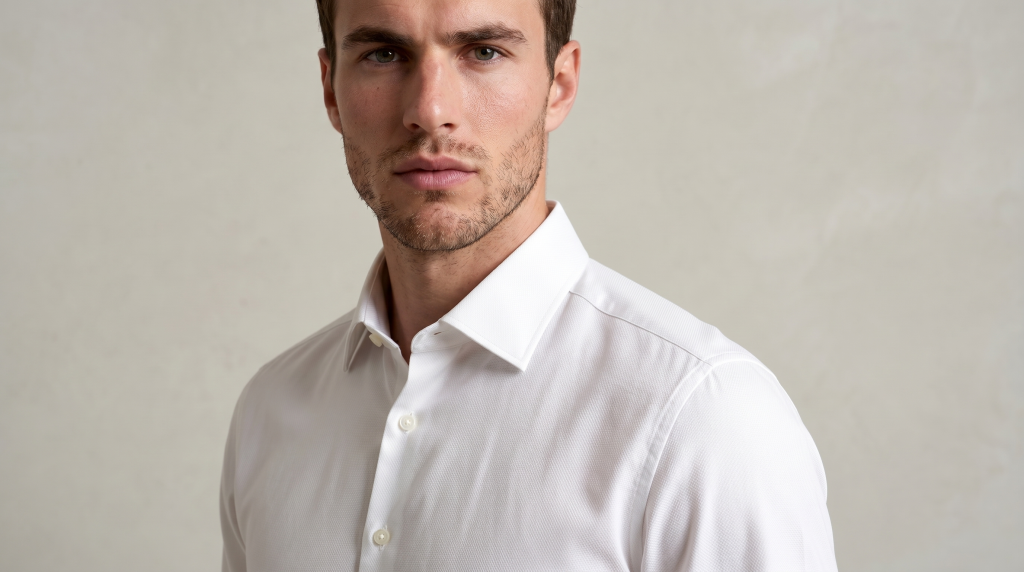
This is the most important measurement in a shirt. The shoulder seam should sit exactly at the edge of the shoulder — not a centimetre over, not under. When it falls too far down the arm, the entire garment hangs incorrectly. No amount of tailoring can easily fix a shoulder that is cut for a different body.
02
The collar
A correctly fitted collar lies flat and close to the neck without pressing against it. You should be able to fit two fingers between the collar and your neck — no more. A collar that gaps when you turn your head is too large. One that restricts movement is too small. Both affect how you present yourself.
03
The chest
The shirt should follow the natural shape of your torso without pulling at the buttons or hanging loosely. When you raise your arms, it should move with you. A shirt that bunches at the sides or stretches across the chest is built for a different proportion.
04
The sleeve length
The sleeve should end at the base of your thumb — precisely at the wrist bone. This allows the cuff to show slightly below a jacket and ensures the shirt moves correctly when you reach. Most standard shirts compromise here by offering only one or two sleeve lengths per size.
05
The body length
A shirt that is too short will come untucked. One that is too long creates excess fabric at the waist and hips. The correct length depends on your torso — a measurement standard sizing rarely addresses precisely.
What made-to-measure actually changes
Made-to-measure does not mean expensive alterations to a garment that was never designed for you. It means the garment is built around your measurements from the start — before a single cut is made.
Your shoulder width determines where the seam falls. Your collar measurement determines the neck opening. Your sleeve length is cut to your arm, not to an average. The chest and waist are shaped to your proportions. Every point where a standard shirt compromises becomes a point of precision.
The result is a shirt you do not have to think about. It does not require adjusting. It does not require breaking in. It fits on the first wear, and it continues to fit.
This is why the men who wear made-to-measure rarely return to standard sizing. It is not about luxury for its own sake. It is about ending a compromise that was never necessary in the first place.
"When the shirt is right, you stop noticing it entirely. That is the point."
Find your shirt
Not sure which fabric or fit is right for you? The Shirt Finder takes five questions.